For risk management, our group has appointed the President as “Chief Administrator” and the Officer in charge of the Business Management Dept. as “Promotion Manager”. We are making efforts to improve our risk management system and its operation and create one that integrates risk management to prevent risk with crisis management, to handle serious risks when they occur.
Moreover, we have established the Risk Management Committee, which is chaired by the corporate officer appointed by the President(regular meetings twice a year and extraordinary meetings as necessary) as one of our special committees to promote company-wide risk management practices. Important decisions made by the committee are reported to the Board of Directors through the Management Meeting.
In FY2025, the Risk Management Committee held twice to report on and discuss strategic risk management, responses to priority risks and updates to the risk map.
Integrated Risk Management
In order to identify and limit those risks that could have serious impacts on our business continuity and on the achievement of our targets, we follow the risk management process as described below. We also evaluate the ESG-related risks including those concerning climate change and human rights.
We identify specific business and other risks for each business process and assess risks by analyzing their degree of impact and likelihood of occurrence, as well as the status of countermeasures in place, to determine whether or not they will have a significant impact on business continuity and goals throughout the company. Any risks determined to require priority action are designated as priority risks with a lead department promoting risk reduction activities, and the Risk Management Committee checks on the status of mitigation activities for these risks.
In FY2025, four priority risks were identified each for Japan and globally and efforts were made to reduce them. Furthermore, with the aim of incorporating strategic risks into integrated risk management from a management perspective, we defined strategic risks as "risks that hinder the achievement of the goals of the medium-term management plan" and identified risk elements. Among business risks, themes such as (1) World affairs and exchange rate fluctuation, (6) Procurement, and (9) Information security are also covered under major initiatives of "Key Management Priorities" and are recognized as important issues for sustainability management.
- <Business risks>
-
- 1. World Affairs and Exchange Rate Fluctuation Risks
- 2. Business Environment Risks
- 3. Product Quality Risks
- 4. Technological Development Risks
- 5. Intellectual Property Risks
- 6. Procurement Risks
- 7. Natural Disaster and Infectious Disease Risks
- 8. Environmental Risks
- 9. Information Security Risks
- 10. Human Resource Securement Risks
- 11. Compliance Risks
- 12. Business Investment Risks
- 13. Human Rights Violation Risks
For more information on each of these matters, please refer to the Annual Securities Report via the link below.
Handling Crisis
If there is an apparent risk that causes a serious impact on business continuity, a crisis response team with the president as the chief executive officer is immediately formed to handle the situation. The crisis response team will respond to emergencies by collecting and analyzing information, deciding and instructing countermeasures, and contacting and coordinating with related organizations.
Moreover, in the event of an important incident, accident, disaster, etc., we have prepared an emergency contact email system that allows the department in which the incident occurred to notify the officers, the Business Management Dept., and related departments simultaneously.
Business Continuity Management (BCM)
In preparation against possible earthquakes and other large-scale disasters, we are conducting BCM activities. Specifically, we are making business continuity plans and working on disaster control and reduction on a group-wide basis to minimize damage in the event of a large-scale disaster and resume production as soon as possible if operation is suspended, thereby helping customers maintain their supply chains.
We are also continuing to develop and maintain systems to prepare for future contingencies regarding infectious diseases, including COVID-19.
Major Initiatives Related to Business Continuity Plans (BCPs)
We have made a BCP for each of our departments. Each plan defines the initial response to be made and recovery procedures to be followed in case of emergency.
- <IT Departments>
- To ensure our business continuity, we are continuously working to minimize the damage that might be caused to our IT systems in the event of a disaster and speed up the time required for recovery.
Specifically, we aim to minimize the damage by moving the system to a highly robust data center. Also, to shorten the recovery time, we are shifting to cloud backups so that we can recover and restart the systems by using undamaged backups, including group companies.
We are currently moving the system itself to the cloud, and will work to further strengthen business continuity.
Moreover, we are regularly providing more specific and practical education and training so that employees can make better responses in case of a disaster.
- <Procurement Departments>
- We are fostering BCP measures for key procurement items such as materials and parts, including purchasing from multiple suppliers. In view of the fact that we need a range of materials and parts to manufacture our products, we have built up a system to implement BCP measures across the supply chain in cooperation with suppliers.
- <Production Support Engineering Department>
- We are implementing earthquake-resistant measures for our buildings and ancillary facilities in preparation for the Nankai Trough Earthquake. We have a checklist to ensure if entering the building is possible in the event of an earthquake, and we are promoting building inspection drills at each site.
Once entering the building, the recovery team inspects the infrastructure and ancillary facilities according to the procedures stipulated in the BCP and implements recovery activities according to the priorities.
- <Business Departments>
- In the BCP made for each department, we set a limit for the recovery time required for our major products. We also formulate action plans for the recovery teams to achieve early recovery.
- <BCP Training>
- We conduct BCP training every December for the purpose of resuming business as soon as possible in the event of a disaster. BCP training is designed to improve the effectiveness of BCPs by formulating recovery plans for the major businesses, organizing recovery teams and implementing recovery activities. To prepare for a situation where our internal network is unavailable, we conduct training on communicating with the emergency headquarters using IP wireless equipment and sharing information via the internal portal.
Major Disaster Control and Disaster Reduction Activities
- <Implementation of the Joint Disaster Prevention Drill>
- In anticipation of a Nankai Trough Megathrust Earthquake, we are implementing the Company-wide Disaster Prevention Drill as a joint drill for domestic Group companies. The drill includes training for evacuation, confirmation of employees’ safety, incipient stage firefighting, and inspection of damage caused to facilities and equipment and is designed for early recovery in the event of an emergency.
 Evacuation training
 Headquarters operation training
- <Measures Against Storm and Flood Damage>
- Recently, climate change has been causing more extensive storm and flood damage. In response, we will work to minimize damage by making disaster-specific timelines for each of our business locations and checking local hazard maps annually, etc.
- ・Measures against the outflow of hazardous materials in the event of a flood
In order to prevent the outflow of chemicals and oil in the event of flooding due to heavy rain, we investigated the risk of flooding at each site of our group companies.
At sites with a risk of flooding, we take appropriate measures, such as storing hazardous substances in sealed containers, placing sandbags, and creating and operating disaster prevention procedures.
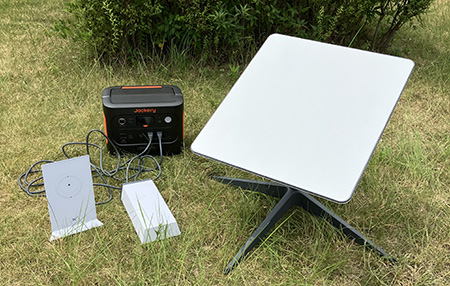
- <Disaster Communication Equipment: Introduction of Starlink>
-
To ensure communication between bases in the event of communication failures during disasters, in addition to existing satellite phones, we have introduced the satellite internet service "Starlink" to all domestic sites.
By establishing redundant communication channels, we enable the collection and provision of disaster information and emergency notifications, aiming to strengthen our framework.
- <Raising Employees’ Awareness of Disaster Prevention>
- In order to enhance the disaster response capabilities of our employees and foster our business continuity, we have established a "Disaster Prevention Awareness Month" and are educating them on guidelines for action in the event of a disaster, even during normal times.
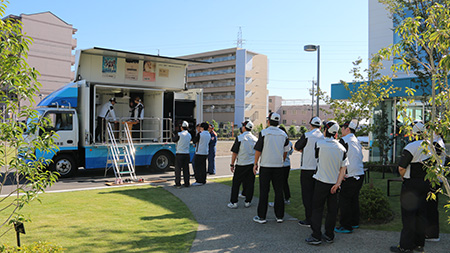 Disaster Awareness Month: Earthquake simulator experience event