
The earth’s resources are limited and must be therefore conserved and used sustainably. As a manufacturing company, our Group uses a variety of raw materials, including ceramics and rare metals, and we believe it is our responsibility to actively engage in 3R (reduce, reuse and recycle) activities to conserve the global environment. In Eco Vision 2030, our Group has set out our vision for 2040 to “contribute to a global recycle-oriented society by promoting zero waste emissions” and set the targets of “achieving an over 95% effective utilization rate,” “reducing at least 1% waste intensity compared to FY2018,” and “promoting 3R activities,” as milestones to be achieved in 2030.
We will also promote sustainable and efficient use of raw materials and other resources in our supply chain.
In Eco Vision 2030, we set a target of “reducing at least 1% waste intensity compared to FY2018” as our target for 2030. The waste intensity in FY2025 was 0.057 tons/million yen for the entire Group, resulting in a 24.4% reduction compared to FY 2018. We will continue to promote process improvement to reduce waste.
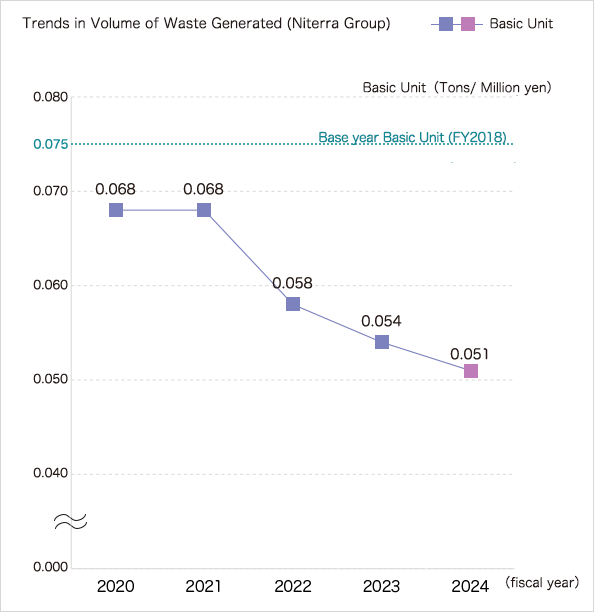 Trends in Waste Intensity (Niterra Group)
In our Eco-Vision 2030, our group has set a target of achieving an "effective utilization rate of 95% or higher" by 2030. The effective utilization rate for the entire Group in FY2025 was 96.0%, unchanged from the previous year. We will continue to work on the effective utilization of waste.
We are reducing the amount of raw materials required by making products lighter and smaller.
Case Study: Miniaturization of Spark Plugs
Through the development of high-voltage resistant alumina insulation materials that resist dielectric breakdown even when made thinner, we have miniaturized spark plugs and suppressed the use of resources.
We are reducing process loss by improving machining accuracy and lowering defect rates through the optimization of processing conditions and improvements in setup procedures.
Case Study: Optimization of Sheet Forming Conditions
In the ceramic sheet manufacturing process, we reduce process loss by optimizing raw material mixing and coating speeds, and by suppressing distortion through precise thickness control, which reduces cracks during drying and minimizes scraps.
We promote paperless operations company-wide across all departments to reduce paper consumption.
Case Study: Digitization of Materials
In addition to digitizing training materials and educational booklets for employees, we have implemented the electronic signing of contracts and the online distribution of materials—such as the Integrated Report, Sustainability Data Book, and CSR/Sustainability Procurement Guidelines—with the cooperation of our stakeholders. We will continue our efforts to go paperless to contribute to a sustainable society.
We use our production equipment for a long period by performing in-house repairs and restoration. Even when equipment has completed its initial role, we reuse and utilize it effectively within the company. Furthermore, we repurpose equipment across different business segments to adapt to fluctuations in production volume, such as increases or decreases, based on market needs.
Case Study: Reuse of Cold Forging Machines
Cold forging machines previously used at an overseas site have been repaired and are being reused in Japan.
Case Study: Repurposing Equipment
Equipment previously used in the semiconductor business has been modified and repurposed for the sensor business.
We develop equipment by standardizing specifications as much as possible to ensure they can be used across different business segments. This allows for the partial reuse of components, such as equipment bases and control panels, in different processes.
Case Study: Production Application of Standardized Equipment
In a part of the manufacturing process for industrial ceramic Parts, we have introduced standardized equipment based on plans for future process changes.
Our group promotes material recycling to effectively utilize limited resources. Additionally, from the perspective of reducing CO2 emissions, we are advancing the material recycling of waste that was previously subjected to thermal recycling.
Major waste recycling methods
| Type of waste | Recycling methods |
|---|---|
| Metal waste | Refined and recycled as a raw material of the same quality. |
| Sludge, which is mainly pre-fired ceramic material. | Reused as a ceramic raw material or a recycled fill material. |
| Waste glass and ceramics (pre-fired ceramic powder, pre-fired sheet scraps, and post-fired ceramic scraps.) | Ceramic powder with high purity is reused as a ceramic raw material, while the rest is reused as a raw material for cement. Ceramic scrap is reused as a roadbed material. |
| Waste oil | Distilled and reused as fuel. |
| Plastics | Crushed and reused as raw materials for plastics or converted into RPF (solid fuel). |
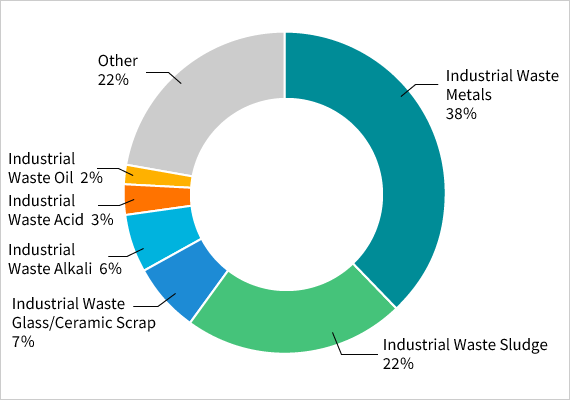 Rate of each waste
As part of efforts related to the Plastic Resource Circulation Act, our Group promotes reuse of packaging materials and material recycling of waste plastics.
The reuse of packaging materials is an initiative that transcends the boundaries of our Group. Packaging materials that cannot be reused within a company are provided to other companies for reuse. Companies who have received packaging materials have seen a decrease in new purchases of packaging materials.
The material recycling of waste plastics is an initiative to switch from thermal recycling to material recycling. In our Group's manufacturing processes, a large amount of waste plastic containing ceramic components is generated. Due to the nature of the manufacturing process, some waste plastic is inevitably generated. We have been working to reduce the amount of waste plastic generated as much as possible through process improvements. Since 2021, we have been fully promoting material recycling initiatives, and by 2024, all ceramic scraps generated during the manufacturing of ceramic sheets could be material recycled. We continue to implement this process as part of our ongoing operations.
In addition, as part of efforts to transform waste into valuables, we compress waste styrene foam, which used to be thermally recycled, into ingots using a volume reduction machine.
We will continue to promote the recycling of plastic resources in the future.
Despite our active efforts (including awareness-raising) to reduce food waste in company cafeterias, there is still food waste generated. Food waste generated from the cafeteria at the Komaki Plant is transported to a biogas power plant in Komaki City, where it is converted into biogas through methane fermentation and is effectively used as fuel for power generation.
We regularly visit our waste disposers to confirm that consigned waste materials are being processed in accordance with our agreement. In FY2024, we visited 32 companies and confirmed that their waste was properly disposed of.
Our Group promotes initiatives to use resources efficiently throughout the entire product life cycle.
By providing highly durable and high-strength products, we reduce the frequency of replacement during use.
Case Study: Supply of Spark Plug Using a Precious Metal (Iridium Alloy)
By using iridium alloy for the electrodes of spark plugs, which are replacement parts, we achieve both improved performance and longer life.
We provide services to restore components whose performance has degraded through use, making them ready for reuse.
Case Study: Refurbishment Service for Electrostatic Chucks
For electrostatic chucks, which are critical components of semiconductor manufacturing equipment, we precisely restore worn or deteriorated surfaces to enable reuse.
We view end-of-life products as valuable resources and are promoting initiatives to collect and reuse them.
Case Study: Oxygen Sensor Collection in North America
In the North American market, we collect and recycle end-of-life oxygen sensors.