
We are aware that a wide range of people are affected by the business activities of our Group, including not only employees of our Group but also employees in the supply chain and local residents. Based on the United Nations Guiding Principles on Business and Human Rights, we are committed to respecting human rights through the establishment of a mechanism to identify, assess, prevent, mitigate, and remedy negative impacts of our business activities on human rights.
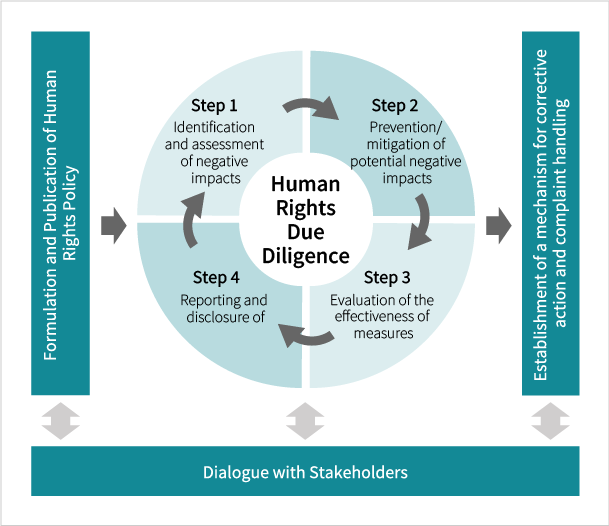 Overview of Human Rights Initiatives
Based on our Human Rights Policy, each department and specialized committee within our Group is driving initiatives to address human rights issues in their respective areas.
In response to the globally accelerating focus on 'Business and Human Rights,' relevant departments—including Risk Management, Compliance, Human Resources, Procurement, and Sustainability—have engaged in continuous discussions since FY2022 to ensure the ongoing implementation and enhance the effectiveness of our human rights due diligence.
Starting in FY2026, the Human Rights Subcommittee, established under the Compliance Committee, will continuously monitor our human rights due diligence processes, as well as deliberate and evaluate related issues. Important matters identified through this process are reported and submitted to the Board of Directors via the Management Meeting. Through these structured procedures, we have established an effective promotion system under the strict supervision of the Board of Directors.
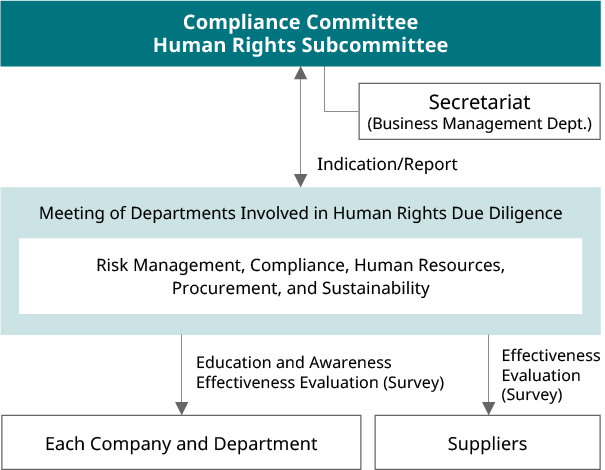 Human Rights Promotion System
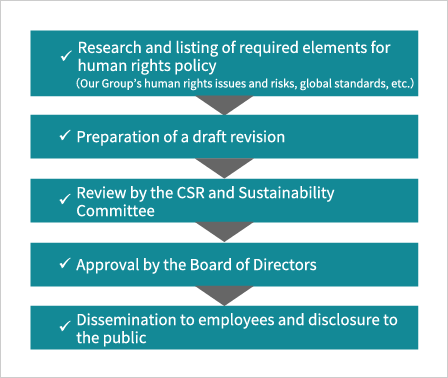
Since establishing our Human Rights Policy in 2020 as part of our CSR Basic Policy, we have reviewed its content annually and as needed.
In January 2023, recognizing the growing importance of corporate initiatives to respect human rights and the need for such efforts not only within our Group but throughout the entire value chain, we fully revised the Human Rights Policy to align with international norms and other standards. At the same time, we specified examples of human rights to be respected in an Appendix to the policy. The revision was made based on advice from external human rights experts and after extensive discussions among departments involved in implementing human rights due diligence. The revised policy was then reviewed by the Sustainability Committee and approved by the Board of Directors. Furthermore, in December 2024, we revised the Appendix to the Human Rights Policy to include items concerning "the rights of Indigenous peoples and local communities" and "respect for human rights in security operations."
We are working to identify, assess, prevent and mitigate human rights risks related to the business operations of our Group.
In identifying human rights risks, we organized the Group’s major value chains and related stakeholders and extracted commonly assumed human rights risks for each value chain. We then organized the Group’s human rights risks by referring to reports from international organizations, media databases, and other surveys, as well as benchmarks from other companies. We then conducted a human rights impact assessment and mapping, and identified priority human rights risks.
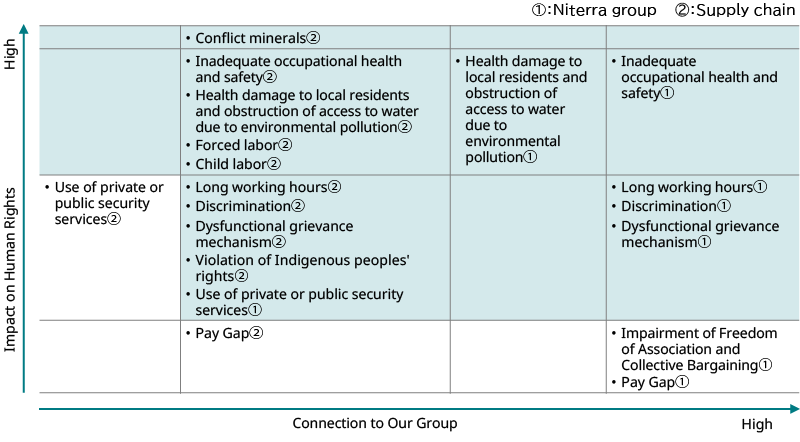 Impact on Human Rights: Assessed based on severity (scale, scope, and irremediable character) and likelihood.
| Our Group | Supply Chain |
|---|---|
|
|
Based on these results, we are currently advancing our initiatives to respect human rights, focusing on our Group and supply chain where we can exert direct influence, and prioritizing the human rights risks identified as key areas.
| Human Rights Risks | Key Initiatives |
|---|---|
| Inadequate Occupational Health and Safety | To eliminate lost-time injuries, we continuously implement safety measures, including engineering controls for equipment and thorough risk assessments. |
| Health Damage to Local Residents and Obstruction of Access to Water Due to Environmental Pollution | To mitigate the risks of environmental accidents and pollution, each site establishes voluntary standards based on legal regulations and municipal agreements for air, water quality, noise, and vibration, conducting regular measurements and maintenance management to protect local communities and resources. |
| Long Working Hours | To prevent long working hours, we establish work rules (such as setting no-overtime days, prohibiting late-night work and overtime exceeding 5 hours a day in principle, and ensuring a 10-hour rest interval between shifts), reduce working hours through labor-management agreements, and visualize discrepancies between PC logs and time clock data. |
| Discrimination | We raise awareness and caution against discrimination by providing specific examples of discriminatory behavior in our Compliance Guidebook distributed to employees and in our "Compliance Newsletter" e-mail magazine. |
| Dysfunctional Grievance Mechanism | To enhance the awareness and effectiveness of the whistle-blowing system at our overseas group companies, we ensure widespread notification through the Global Compliance Guidebook. |
| Use of Private or Public Security Services | As security conditions vary by business site and plant, we implement tailored security operations appropriate to each specific situation. |
Regarding human rights risks in our supply chain, we distribute the 'Sustainability Procurement Guidelines' to our direct suppliers. Furthermore, we monitor the situation through regular surveys and, where improvements are needed, provide remediation support through dialogue. We also recognize that the identified human rights risks can change due to shifts in social conditions, the progress of our Group's business, and the development of new business partners. Therefore, to enhance the effectiveness of our initiatives, the departments involved in implementing human rights due diligence take the lead in periodically reviewing the risk map.
We periodically monitor the status of respect for human rights within our Group and supply chain by conducting surveys.
We conduct compliance awareness surveys of employees and human rights and labor surveys of group companies to identify human rights violations and potential human rights risks.
To promote sustainability efforts throughout our supply chain, we issued the Sustainability Procurement Guidelines, which have been deployed to suppliers. The guidelines include compliance matters related to human rights, including labor, safety, and health.
To monitor the status of implementation by suppliers, we conduct surveys every two years using a checklist and provide feedback on the results. For suppliers that require follow-up activities, we visit them to check the situation. We also provide support as appropriate when improvements are needed.
Additionally, starting in FY 2025, we have also begun conducting surveys for the suppliers of our group companies.
| Our Group | Compliance Awareness Survey |
|
|---|---|---|
| Human Rights and Labor Survey |
|
|
| Supply Chain | Survey using the Sustainability Procurement Guidelines check sheet |
|
For any issues or potential human rights risks identified through these surveys, we implement corrective measures as necessary and work to prevent their occurrence.
For instance, in FY2024, we discovered that a group company in Thailand was conducting pre-employment pregnancy and infectious disease tests, citing workplace safety considerations. As this could potentially lead to discrimination, we abolished these tests in accordance with international human rights standards. We also confirmed that no other group companies were conducting similar tests.
Risks related to human rights cannot be completely eliminated and will continue to exist, even with systems such as human rights due diligence in place. This is because such risks often stem from the limitations of these systems, unforeseen events, and the complexity of the issues themselves; furthermore, human rights standards vary by country, region, and era. To mitigate these risks, we conduct annual surveys covering Niterra and its group companies, and will continue to maintain processes for prompt corrective action and disclosure regarding any identified cases.
| Human Rights Issue | Initiative | Specific Actions |
|---|---|---|
| Working Conditions and Equal Opportunity | Revision of the Notice of Working Conditions | We reviewed the content to make working conditions easier to understand prior to employment, adding supplementary information regarding the flextime system and the timing for tendering resignation. We also provided instructions on how to view the referenced internal regulations. |
| Comfortable Workplace Environment | Evacuation Drills at Company Dormitories | To ensure employee safety, we made preparations to conduct evacuation drills at company dormitories and housing. These drills are currently being rolled out sequentially. |
| Responsible Procurement of Resources and Materials | Raising Awareness of Conflict Minerals | To increase awareness regarding conflict minerals, we conducted awareness-raising initiatives for the relevant group companies. |
We have established multiple contact points to receive feedback, questions, and requests from our stakeholders, including customers, suppliers, and employees.
Reports and consultations regarding human rights from suppliers and employees are accepted through whistle-blowing hotlines established in accordance with the laws and regulations of each country.
We have established an operational process for handling received consultations and reports; this involves conducting factual investigations and taking corrective actions as necessary, while strictly ensuring user anonymity and the prohibition of disadvantageous treatment as stipulated in our internal regulations. This process also includes notifying the user of the outcome (unless they are anonymous) and follow-up checks to confirm they have not experienced any disadvantageous treatment after reporting or consulting.
In accordance with the Whistleblower Protection Act, contact points for the Corporate Ethics Helpline (an internal whistle-blowing system) are in place internally and externally. These contact points support both Japanese and English, accept anonymous reports, and offer services outside working hours and on holidays. The helpline is available for our suppliers and our group employees. Furthermore, starting from FY2026, we have expanded the scope of the external contact point to allow job seekers to use the service as a measure against job-hunting harassment.
Respective group companies have contact points for whistle-blowing available in the local language.
We implement various dialogue processes to foster mutual understanding with our stakeholders.
With the labor union, which represents employees, we hold regular labor-management meetings to discuss working hours and other matters, and maintain a routine dialogue process with departments involved in human rights due diligence. For our suppliers, we receive consultations through the consultation desks, and other channels, and engage in discussions and necessary corrective actions regarding the cases received. For our customers, we disclose the status of the Group's human rights and labor initiatives by responding to external audits and assessments by RSCI and RBA. For residents living near our plants, we exchange opinions with their representatives, including whether there are any issues that could threaten their living environment. Furthermore, in FY2025, we held a dialogue between an attorney specializing in human rights and the executive officer in charge.
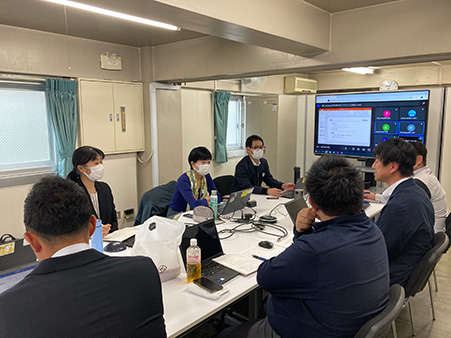 Dialogue with the labor unions
We conduct education and raise awareness based on our Human Rights Policy.
We distribute the "Compliance Guidebook" (and the "Global Compliance Guidebook" for overseas operations) to employees working across the Group.
The Compliance Guidebook is a booklet that compiles corporate and social rules. It is used to check the correct actions to be taken as a member of the Niterra Group when one is unsure of how to judge a situation. This guidebook also stipulates compliance matters related to human rights, including respect for human rights and various types of harassment prohibited by international human rights standards and local laws and regulations (e.g., harassment related to pregnancy, childbirth, childcare leave and family care leave, as well as sexual harassment, including that directed against people of the same gender and in relation to sexual orientation or identity, power harassment, and moral harassment). The guidebook is also used in daily awareness-raising activities, such as being read through at the workplace.
In our human rights training targeting employees of our domestic Group, participants watch a video on the necessity of respect for human rights, the Group’s Human Rights Policy, human rights due diligence and remedies, and they take a check test to confirm their understanding. In addition, we work to raise awareness about gender equality and LGBTQ+ issues through various training programs and e-mail newsletters.
In July 2021, we publicized “My Declaration of Human Rights” to show support for the “My Declaration of Human Rights” project promoted by the Ministry of Justice.
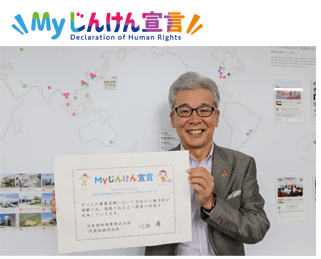 President Suzuki holding a declaration card
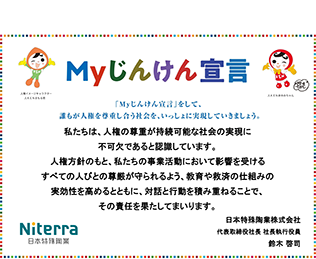 “My Declaration of Human Rights”