
Recognizing the conservation of biodiversity as a critical global challenge, Niterra Group identifies it as a material environmental issue for us to address, along with global warming mitigation and resource recycling.
For this reason, in April 2013 we established the Niterra Group Biodiversity Action Guidelines, which outline our policy on biodiversity conservation.
The Niterra Group recognizes that biodiversity is essential for a sustainable society and that the use of energy and resources and emissions of environmentally hazardous substances have an impact on biodiversity. We will work with our suppliers and external organizations to reduce environmental impact in all our business activities and promote actions to conserve biodiversity.
Using the Niterra Group Biodiversity Action Guidelines as a guide, while being fully aware that our activities, particularly involving the use of energy and resources, are inevitably causing impacts on biodiversity, we will continue working to reduce such impacts throughout our business operations, in cooperation with our suppliers and external organizations.
The closed land-based aquaculture system provided by our group company Niterra AQUA features a structure that recirculates aquaculture water using water quality control sensing technology.
This system is designed to reduce dependence on natural fishery resources and curb overfishing, while reducing environmental impact through the recycling and reuse of aquaculture effluent. Furthermore, it supports water temperature management utilizing unutilized heat sources—such as waste heat from nearby plants and power stations, hot springs, and geothermal energy—as well as installation on existing idle land, including former factory sites and parking lots.
The Ise Plant has introduced a “closed system” for production wastewater in order to protect the rich nature of the surrounding area. Production wastewater is not discharged outside the plant site and is purified and reused on site.
In the area surrounding the “SUISO no MORI hub” established in a corner of the Komaki Plant, we have planted tree species primarily native to the region, such as Japanese white oak, Japanese holly, and Japanese spindle tree, creating an environment harmonized with the local natural surroundings.
Additionally, at the Satsuma Plant, after tree management operations on the premises, we select and plant species such as plum trees that were traditionally planted in the area.
As one of the activities outside the business activities, together with Komaki City, Komaki City Natural Environment Watchers (citizens registered with the city through an open application), and neighboring companies, we are working on extermination of the invasive alien species lanceleaf coreopsis in Komaki City every year.
Additionally, starting in fiscal year 2024, we participated in the removal of lanceleaf coreopsis around the Kuguri district in Kani City at the Nittoku Spark Tech WKS Nino Plant. We plan to continue these efforts going forward.
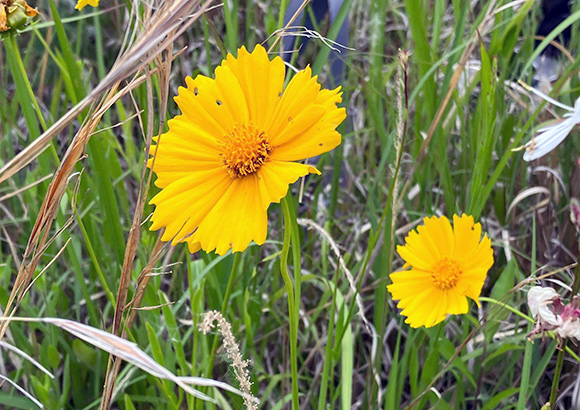 Lanceleaf coreopsis
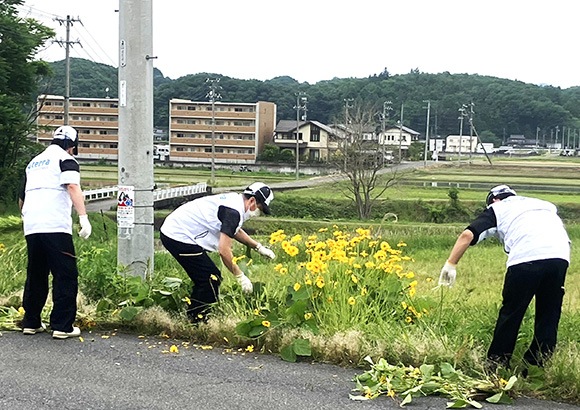 Extermination of lanceleaf coreopsis
To further advance our biodiversity conservation efforts, we joined the Taskforce on Nature-related Financial Disclosures (TNFD) Forum in October 2023.
In January 2024, we declared our intention to disclose information aligned with the TNFD Recommendations published in September 2023 by fiscal year 2025 and completed our registration as a TNFD Early Adopter. Through this, we will advance transparent disclosure of information regarding nature-related risks and opportunities, fulfilling our accountability to all stakeholders.

To enhance employee awareness of the relationship between our Group's business activities and biodiversity, we conducted video training for employees of our company and domestic Group companies in FY 2023 and FY 2025. Employees watched videos covering the importance of biodiversity, global trends, understanding dependencies and impacts within our Group's value chain, and our Group's stance on the matter. Understanding was confirmed through a check test. This video is also available for viewing anytime on the intranet.
To enhance our efforts to mitigate climate change, the Group participates in the following: