
Currently, the loss of biodiversity is progressing at an unprecedented rate globally, causing a wide range of social issues through the degradation of ecosystem services. Our Group considers the resolution of these social issues, including biodiversity loss, as one of our Key Management Priorities. Furthermore, under our medium- to long-term environmental vision, "Eco Vision 2030," we analyze the impacts of our business and products on society as well as on our own operations, and we are currently working on 13 prioritized issues identified as having significant impacts. Towards achieving a Nature-Positive society, we will further evolve our initiatives by incorporating the core principles of the TNFD recommendations.
The TNFD recommendations require organizations to disclose "General Requirements" consisting of six items as premises and basic understandings common to the entire disclosure report. Our Group's position on these items is explained below.
Our Group adopts a "double materiality" perspective when identifying Key Management Priorities (materiality). In assessing nature-related issues, we also applied "double materiality" to evaluate both directions: the impacts our business has on nature and the financial impacts our business receives from nature.
In this assessment, we identified nature-related risks for representative products in our three core businesses (Automotive business, Ceramic business, and New business), covering their respective value chains. This ensures that the scope of disclosure encompasses the primary domains of our business activities. The scope of disclosure based on this assessment applies commonly across all areas of this report, including the "General Requirements," Governance, Strategy, Risk and Impact Management, and Metrics and Targets. In addition, we will regularly review and update the scope of this assessment and the identified risks and opportunities in line with the progress of the portfolio optimization promoted by Our Group.
Table: Scope of Assessment
| Segment | Representative Products | Upstream | Direct Operations | Downstream |
|---|---|---|---|---|
| Automotive components | Spark plugs, Oxygen sensors | Industry average risk of primary raw materials | Manufacturing | Logistics, Product use |
| Ceramic | Piezoelectric ceramics, Products for semiconductor manufacturing equipment | Industry average risk of primary raw materials | Manufacturing | Logistics |
| New Business | Balls for bearings, Solid Oxide Fuel Cells (SOFC) | Industry average risk of raw materials | Manufacturing | Logistics |
In this disclosure, we conducted assessments for Our Group's production sites (15 sites in Japan and 16 sites overseas). For Niterra Materials, which newly joined the group in June 2025, we will proceed with assessments sequentially.
In this disclosure, we report on Our Group's nature-related issues in line with the TNFD recommendations. Meanwhile, we recognize climate change as one of our critical management issues and have already disclosed information based on the TCFD recommendations. Given that nature-related issues and climate change are inextricably linked and critical environmental challenges, we plan to provide an integrated disclosure of climate change and nature-related issues in our 2026 Integrated Report.
In alignment with the time horizons set under the TCFD, we have defined the periods as follows:
Our Group recognizes that our business activities impact nature, and that Indigenous Peoples, local communities, and affected stakeholders are involved within these processes. To engage in meaningful collaboration during the identification and assessment of nature-related issues, we conducted a study targeting our global production sites to assess their proximity to areas where nature, biodiversity, and ecosystem services are of vital importance to Indigenous Peoples and local communities.
Under our Human Rights Policy, Our Group promotes human rights due diligence for our stakeholders. Regarding our response to stakeholders concerning nature-related issues, we will strive to understand situations as necessary and promote sincere engagement based on this fundamental stance of respecting human rights.
Recognizing that all business activities of Our Group depend on and impact the environment and the underlying biodiversity, we promote environmental initiatives guided by our Environmental Policy and Biodiversity Guidelines. We have established the Central Environmental Committee (with regular meetings twice a year and extraordinary meetings as necessary), which is chaired by a corporate officer appointed by the Chief Environmental Officer (President). The Central Environmental Committee reviews the progress of Eco Vision 2030 and Our Group's environmental issues to pursue continuous improvement. Furthermore, material matters decided by the Central Environmental Committee are reported to the Board of Directors via the Management Committee, which deliberates, decides, and supervises important executive matters, ensuring oversight by the Board of Directors.
We also recognize that Our Group's business activities and biodiversity conservation efforts can affect the human rights of local communities and Indigenous Peoples. Based on our Human Rights Policy, each department and specialized committee handles human rights issues within their respective domains. For initiatives respecting human rights, the Human Rights Subcommittee, established under the Compliance Committee, continuously monitors human rights due diligence and deliberates/evaluates related issues. Important matters from these activities are reported and submitted to the Board of Directors through the Management Committee, establishing an effective promotional structure under the supervision of the Board of Directors.
To grasp the complete picture of nature-related dependencies and impacts in Our Group's business activities, we conducted an assessment covering the entire value chain using "ENCORE," a global evaluation tool for nature-related risks. For the upstream segment, we analyzed the industrial and sector classifications to which our primary raw materials belong. For direct operations, we linked our specific manufacturing processes as a manufacturer to the evaluation items in ENCORE. For the downstream segment, in addition to evaluating the logistics (transportation) sector, we analyzed the dependencies and impacts during the use of final products equipped with our components in the Automotive business, which accounts for 80% of Our Group's net sales. We organized these results into a heatmap and identified high-stakes dependencies and impacts within Our Group's value chain (where the dependency level is "High (H)" and the impact level is "Very High (VH)" or "High (H)").
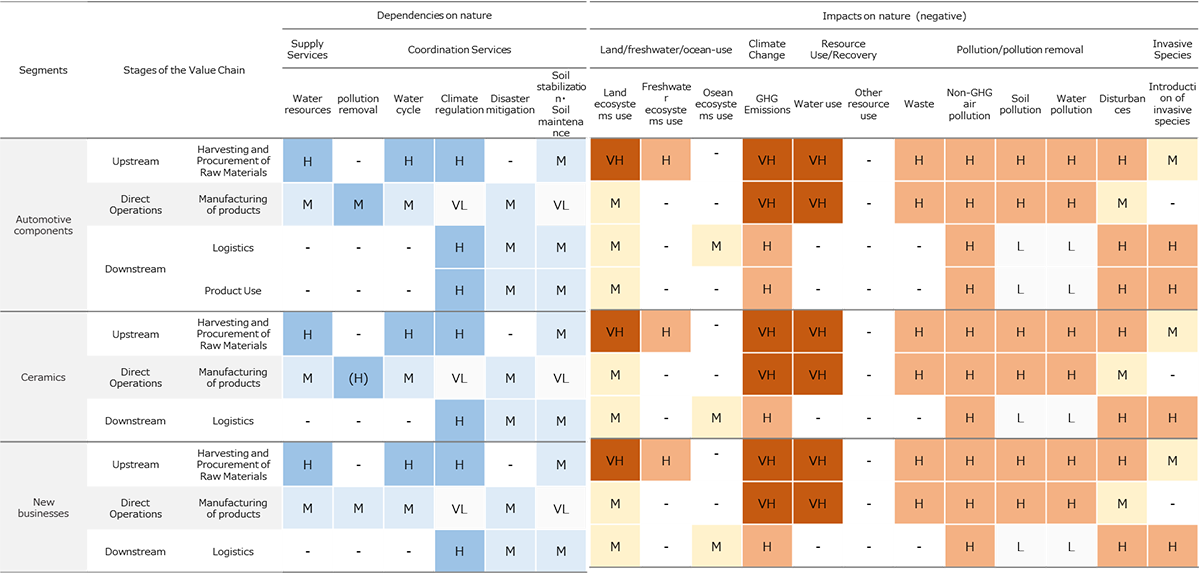 Dependency and Impact Assessment by Business Unit (Heat Map)
Table: Dependencies and Impacts across the Value Chain
| Dependencies on Nature | Upstream |
|
|---|---|---|
| Downstream |
|
|
| Impacts on Nature | Upstream |
|
| Direct Operations |
|
|
| Downstream |
|
Based on the evaluation results of dependencies and impacts, we identified risks and opportunities related to natural capital. Regarding risks, we structured their impact levels and likelihood using scenarios. Out of the four qualitative scenarios recommended by the TNFD based on a four-quadrant matrix, we evaluated "Scenario I: A World of Accelerated Transition and Restored Ecosystems" and "Scenario III: A World of Stalled Transition and Degraded Ecosystems," identifying risks of moderate level or higher.
In accordance with the process proposed in the TNFD Guidance on Scenario Analysis, we utilized four qualitative scenarios based on two axes: ecosystem degradation (physical risk) and alignment of market/non-market drivers (transition risk). Next, to make the scenarios effective for examining risks and opportunities, we specified the direction of changes in external environmental drivers surrounding Our Group under each scenario. We then analyzed the nature-related risks and opportunities in Our Group's business under these projected external environments.
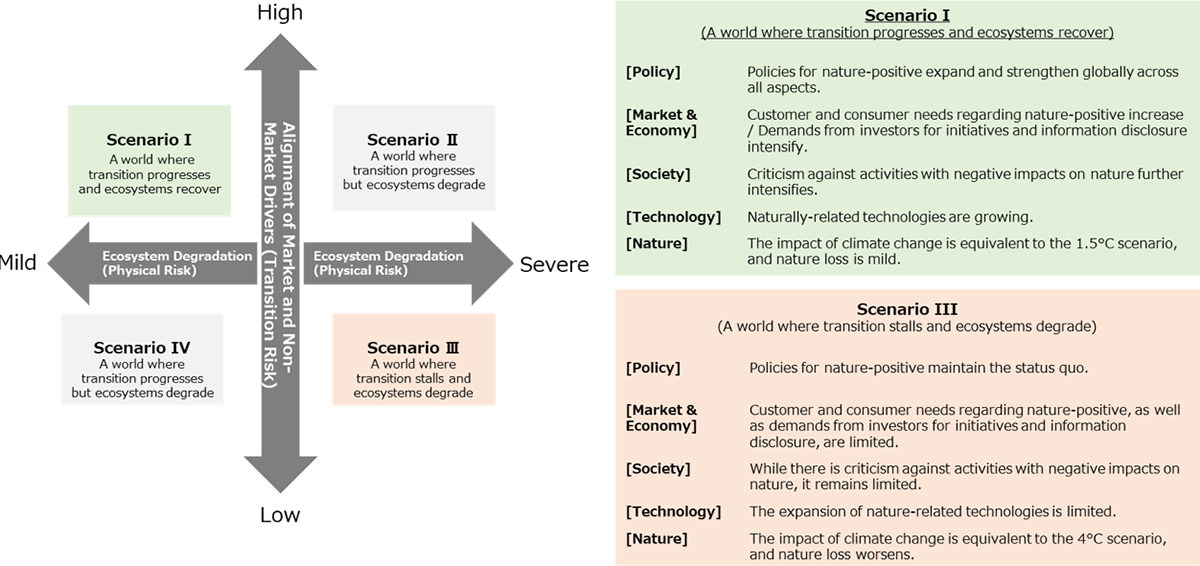 Four Qualitative Scenarios
Scenario I: A World of Accelerated Transition and Restored Ecosystems
| Classification | Related Nature Dependencies/Impacts | Direct Operations / Upstream | Risk Details | Impact Level*1 | Likelihood / Urgency*2 | Priority*3 | Response |
|---|---|---|---|---|---|---|---|
| Transition (Policy & Legal) |
【Impact】 Pollution / Pollution removal | Direct Operations | ● Tightening of regulations and ordinances regarding wastewater. ● Increased capital investment for introducing closed systems and rising operational costs to meet wastewater restrictions. |
Medium | Medium | 4 |
|
| 【Impact】 Resource use / Regeneration | Direct Operations | ● Necessity to comply with regulations/ordinances such as restrictions on virgin materials and mandatory use of recycled materials (including mineral resources). ● Difficulties in raw material procurement and soaring prices due to regulations. |
Medium | Medium | 4 |
|
|
| 【Impact】 Use of terrestrial ecosystems, water use, air/water/soil pollution, waste (mineral producing regions) | Upstream | ● Decrease in mineral supply due to tighter environmental management regulations during mining, and rising mineral prices driven by increased production costs. | Major | Medium | 3 |
|
|
| 【Dependency】 Water supply【Impact】 Resource use / Regeneration | Upstream | ● Decrease in mineral supply due to rising water procurement costs caused by water intake restrictions, and rising mineral prices driven by increased production costs. | Major | Medium | 3 |
|
|
| 【Impact】 Use of terrestrial ecosystems, water use, air/water/soil pollution, waste (mineral producing regions) | Upstream | ● Raw material supply shortages and price hikes due to the introduction of harvesting/mining regulations (including land conversion) for nature conservation. | Medium | Medium | 4 |
|
|
| 【Dependency】 Water supply【Impact】 Resource use / Regeneration | Upstream | ● Raw material supply shortages and price hikes due to the tightening of regulations/ordinances regarding water intake from surface/groundwater. | Medium | Medium | 4 |
|
Scenario III: A World of Stalled Transition and Degraded Ecosystems
| Classification | Related Nature Dependencies/Impacts | Direct Operations / Upstream | Risk Details | Impact Level*1 | Likelihood / Urgency*2 | Priority*3 | Response |
|---|---|---|---|---|---|---|---|
| Physical (Acute / Chronic) | 【Dependency】 Climate regulation, disaster mitigation, soil stability | Direct Operations | ● Damage from wind, flood, and landslides at production sites due to the decline in nature's disaster mitigation and soil stability functions caused by surrounding regional development. | Medium | High | 3 |
|
| Physical (Acute / Chronic) | 【Dependency】 Climate regulation, disaster mitigation, soil stability | Upstream | ● Damage from wind, flood, and landslides across suppliers and procurement networks due to the decline in nature's disaster mitigation and soil stability functions caused by surrounding regional development, making raw material procurement difficult. | Medium | High | 3 |
|
| Physical (Chronic) | 【Dependency】 Climate regulation, disaster mitigation, soil stability | Upstream | ● Damage from wind, flood, and landslides across suppliers and procurement networks due to the decline in nature's disaster mitigation and soil stability functions caused by the degradation of nature in surrounding regions, making raw material procurement difficult. | Medium | High | 3 |
|
| Physical (Acute) | 【Dependency】 Water supply | Direct Operations | ● Degradation of water resources and instability of water supply due to over-extraction and water pollution (including over-extraction/pollution by third parties upstream). | Small | High | 4 |
|
| Physical (Chronic) | 【Dependency】 Water supply | Direct Operations | ● Decrease in water resource volume due to the decline in nature's water retention and recharge capacities. ● Water quality deterioration due to the decline in water purification capacity. |
Small | High | 4 |
|
| Physical (Chronic) | 【Dependency】 Water supply | Upstream | ● Decrease in water resource volume due to the decline in nature's water retention and recharge capacities. ● Water quality deterioration due to the decline in water purification capacity. |
Small | High | 4 |
|
*1 Impact levels are as follows. Evaluated based on the highest impact in business continuity, trust/brand, and economics.
| Impact on Business Continuity | Impact on Trust and Brand | Financial impact | |
|---|---|---|---|
| Critical | Business continuity is difficult. | Permanent loss of trust and brand value (prolonged critical coverage, withdrawal of investment by numerous investors, loss of customers and business partners). | Significantly impact sales revenue |
| Large | Requires fundamental review of facilities and products to maintain business continuity. | Significant loss of trust and brand value (temporary critical media coverage, withdrawal of investment by some investors, loss of some customers and business partners). | Have a major impact on sales |
| Medium | Requires modification and review of facilities and products to maintain business continuity. | Loss of trust and brand value (critical media coverage in some outlets, decline in investor evaluation, expressions of dissatisfaction from many stakeholders) | Have a moderate impact on sales |
| Small | Requires operational adjustments, supplier reviews, and minor modifications to sustain business operations. | Minor impact on trust and brand (expression of dissatisfaction by some stakeholders) | Have a minor impact on sales |
*2 Likelihood/Urgency levels are as follows. Evaluated based on the higher impact factor between the likelihood of occurrence and the timing of occurrence.
| High |
|
|---|---|
| Medium |
|
| Low |
|
*3 Evaluation of Priority:
The priority of each identified nature-related risk is qualitatively and quantitatively classified into four levels from 1 (highest priority) to 4, based on a risk matrix combining "Impact Level" and "Likelihood / Urgency". Regarding the blank areas in the matrix (e.g., where the impact level is 'Medium' or 'Small' and the likelihood/urgency is 'Low'), we have determined that their impact on business management and the natural environment is extremely minor at present.
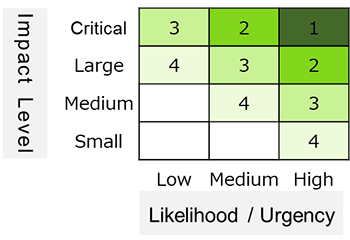 Evaluation of Priority
Based on the assessment process recommended by the TNFD, Our Group extracted locations for nature-related assessments as "Sensitive Locations" and "Material Locations." The collective term for locations falling into either or both categories is identified as "Priority Locations." For Sensitive Locations, we conducted evaluations using international databases such as IBAT and WRI Aqueduct, based on the four perspectives indicated by the TNFD: "biodiversity importance," "ecosystem integrity," "importance of ecosystem service provision," and "water physical risk."
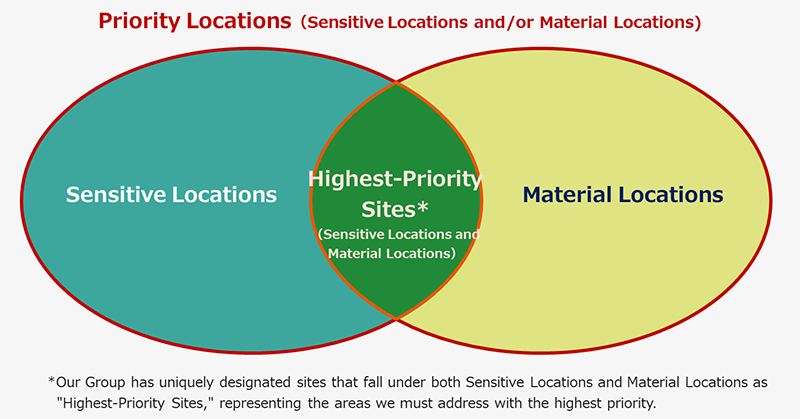 Definitions of Priority Locations and Highest-Priority Sites
| Site | Country | Reason for Selection |
|---|---|---|
| Satsuma plant, SparkTec WKS CO., LTD. | Japan | One of the primary manufacturing plants for spark plugs, located in an area with high biodiversity importance and ecosystem integrity. |
| Niterra do Brasil Ltda. | Brazil | One of the primary manufacturing plants for spark plugs, falling under multiple risk indicators including biodiversity importance, ecosystem integrity, and water physical risk. |
| Siam Niterra Co., Ltd. Niterra Thailand Co., Ltd. Niterra Asia Co., Ltd. |
Thailand | High water consumption in manufacturing processes, and the region faces high water physical risk. |
| PT Niterra Indonesia | Indonesia |
To increase the resolution of nature-related risks and opportunities and implement more effective response measures, we are sequentially proceeding with further detailed assessments for these identified highest-priority sites. The results of the detailed nature-related dependency and impact assessment conducted ahead of others at the Satsuma Plant, along with specific risk response measures based on those results, are disclosed in detail in Appendix ③. Moving forward, we will progressively advance similar detailed assessments for our sites in Brazil, Thailand, and Indonesia.
To properly comprehend nature-related dependencies, impacts, and associated risks and opportunities, Our Group is conducting analysis and evaluation based on the "LEAP Approach" (Locate, Evaluate, Assess, Prepare) recommended by the TNFD.
As practical steps, we have defined the following five "Action Processes" and implemented a systematic approach:
① Understanding the Big Picture (Scoping, Screening of Dependencies and Impacts)
We defined the scope of Our Group's business model and entire value chain, performing an initial screening of points of contact with nature, as well as dependencies and impacts.
② Identifying Priority Sites (Extraction of Sensitive Locations)
We identified the highest-priority sites by overlaying Sensitive Locations that require careful management from an environmental perspective (such as nature importance and water physical risks) with the business materiality of Our Group (For details, refer to "Strategy" and Appendix ②).
③ Identifying Material Risks (Measurement and Prioritization of Risks and Opportunities)
Focusing on the identified priority sites, we identified and assessed the materiality of potential risks and opportunities for Our Group's business activities arising from nature degradation and the tightening of domestic and international laws and regulations (For details, refer to "Scenario Analysis").
④ Investigation and Detailed Assessment of Priority Sites (Strategy and Resource Allocation Plan)
To increase the resolution of specific dependencies and impacts unique to each location against the identified material risks, we formulated a roadmap for detailed assessments (detailed investigations based on the LEAP approach) and are promoting stepwise, in-depth studies.
⑤ Disclosure (Reporting and Publication)
Through this report, we transparently disclose the insights gained through this series of assessment processes, the identified risks and opportunities, and Our Group's resilience (response measures) to our stakeholders.
The Central Environmental Committee will set targets and KPIs, as well as manage performance for material nature-related risks and impacts extracted through the above processes.
As Our Group operates globally across multiple fields and faces various risks and opportunities unique to each business, we grasp and respond to these risks and opportunities on a business-by-business basis. Regarding environmental risks and opportunities, including biodiversity conservation, we will monitor regulatory trends, evaluate their specific impacts on our business, and implement appropriate responses.
The Risk Management Committee analyzes and evaluates risks from an enterprise-wide perspective to determine whether they significantly affect business continuity or target achievement, based on their impact level, likelihood, and status of countermeasures. Risks evaluated as requiring focused responses are designated as "Priority Risks," with a supervising department assigned, and the Risk Management Committee monitors the progress of mitigation activities. We also evaluate ESG-related risks, including environment and human rights, and will include biodiversity-related risks in our evaluations moving forward. Meanwhile, material opportunities are reviewed by the Sustainability Committee and, where necessary, reflected in our business strategies and Priority Management Issues.
Our Group conducts monitoring and sets targets using quantitative and qualitative metrics to assess and manage nature-related dependencies, impacts, risks, and opportunities. In this disclosure, we report our performance along two pillars: the "Global Core Metrics" recommended by the TNFD and the targets set forth in Our Group's "Eco Vision 2030."
To accurately grasp the impacts of our business activities on the environment, Our Group collects environmental performance data across 9 domestic companies and 21 overseas companies (covering all 60 sites), including our headquarters and sales offices. Our Group's response and disclosure status regarding the TNFD Global Core Metrics are as follows.
| Metric No. | Drivers of Nature Change | Indicator | Measurement Metric | FY2024 Data |
|---|---|---|---|---|
| - | Climate change | GHG emissions | * Refer to ISSB IFRS S2 "Climate-related Disclosures" | Disclosed separately (Climate Change Sector) |
| C1.0 | Land/freshwater/ocean use change | Total spatial footprint | ● Total spatial footprint | To be disclosed in the future |
| C1.1 | Land/freshwater/ocean use change | Extent of land/freshwater/ocean use change | ● Scale of land/freshwater/ocean use change (km²) ● Area of land/freshwater/ocean conserved or restored (km²) ● Area of land/freshwater/ocean under connectivity management (km²) |
Not applicable |
| C2.0 | Pollution / Pollution removal | Total weight of pollutants released to soil by type | ● Total weight of pollutants released to soil by type (t) | Not applicable |
| C2.1 | Pollution / Pollution removal | Wastewater discharge | ● Wastewater discharge (Total volume, freshwater, others) | ● Total volume: 1.542 million m³ (By destination) - Freshwater surface water: 1.255 million m³ - Third-party discharge destinations: 287,000 m³ |
| C2.2 | Pollution / Pollution removal | Waste generation and disposal | ● Weight of waste and hazardous waste generated (by type) (t) ● Volume of waste and hazardous waste classified as: - Incinerated - Landfilled - Others ● Volume diverted from landfill: - Reused - Recycled - Other recovery methods |
● Total waste volume: 20,332 t (Breakdown) - Incinerated: 609 t - Landfilled: 1,248 t - Recycled: 16,718 t ● Total hazardous waste volume (Japan): 609 t (Breakdown) - Incinerated: 2 t - Landfilled: 59 t - Recycled: 549 t |
| C2.3 | Pollution / Pollution removal | Plastic pollution | ● Weight of plastic used or sold (t) (by raw material type) ● Percentage of plastic packaging that is reusable / compostable / technically recyclable / practically recyclable at scale (%) |
Not applicable |
| C2.4 | Pollution / Pollution removal | Total non-GHG air pollutants | ・PM ・NOx ・VOCs ・SOx ・Ammonia |
To be disclosed in the future |
| C3.0 | Resource use / Regeneration | Water withdrawal and consumption from water-scarce areas | ● Total water withdrawal and consumption from water-stressed areas (m³) | Total water withdrawal: 239,561 m³ |
| C3.1 | Resource use / Regeneration | Quantity of high-risk natural primary commodities sourced from land/ocean/freshwater | ● Quantity of high-risk natural commodities sourced from land, ocean, and freshwater by type (t) ● Quantity of high-risk natural commodities sourced under sustainable management plans or certification programs (t) |
To be disclosed in the future |
| C4.0 | Invasive alien species, etc. | Placeholder metric: Countermeasures against unintentional introduction of Invasive Alien Species (IAS) | ● Percentage of high-risk activities implementing appropriate methods to prevent accidental introduction of invasive alien species, or percentage of activities designated as low-risk | - |
| C5.0 | State of nature | Placeholder metric*: State of ecosystemsPlaceholder metric: Extinction risk of species | ・Level of ecosystem state by ecosystem type and business type ・Extinction risk of species |
- |
Our Group has formulated the medium- to long-term environmental targets "Eco Vision 2030" toward achieving a sustainable society. Centering on the following "four important issues" which are deeply connected with nature-related issues, we are promoting initiatives by defining our long-term vision (targets) for 2030. We have set quantitative targets for climate change response, water resource conservation, and waste management, and we are continuously monitoring their progress.
| Issue / Focus Area | Our vision for 2040 | The milestone to be achieved in 2030 | FY2024 Target | FY2024 Performance (Results) |
|---|---|---|---|---|
| Responding to Climate Change | Implementing activities toward realization of a decarbonized society. *Achieving carbon neutrality by 2050 |
CO2 emissions reduction compared to FY2018: ・Scope 1 and 2: 46% reduction ・Scope 3: 30% reduction |
CO2 emissions reduction compared to FY2018: ・Scope 1 & 2: 10% reduction ・Scope 3: — |
CO2 emissions reduction compared to FY2018: ・Scope 1 & 2: 31.7% reduction ・Scope 3: 13.4% reduction |
| Conserving Water Resources | Implementing sustainable business operations in response to global water risks | Water consumption intensity: Keep below FY2018 level | 54,000 m³ / million yen | 39,100 m³ / million yen |
| Waste Management | Contribute to a global recycle-oriented society by promoting zero emission | ・Achieve over 95% effective utilization rate ・Reduce at least 1% of waste intensity compared to FY2018 |
・Effective utilization rate: — ・Intensity: 0.075 t / million yen |
・Effective utilization rate: 90.6% ・Intensity: 0.051 t / million yen |
Moving forward, after advancing detailed assessments (in-depth investigations based on the LEAP approach) of nature-related risks and opportunities at the identified highest-priority sites (Satsuma, Brazil, three Thai companies, and Indonesia), we will further consider appropriate metrics and targets to manage Our Group's material nature-related dependencies, impacts, risks, and opportunities with higher precision.